


Ordinary services
We celebrate the Holy and Divine Liturgy every Sunday from 9:30.
The Liturgy, as well as all our services are organised in several languages, also in German, but primarily in Romanian. Important for the English guests: please try to arrive before the service and announce your presence to the priest. Together with a blessing, you will receive a book with the text if the Liturgy in English, and a translator to sit next to you during the service and provide guidance. Also, the priest will know to tailor the service and include some prayers in English, like Our Father.
In front, on the right side of the church, you can follow the Liturgy on a slide show that always indicates the current page from the English book you have received.
Confessions every Friday, 18:00-20:00, without appointment, also possible in English, or German.
For other services, prayers, advice or even for a personal discussion please contact the priest directly.
Special events
Other special services or changes to the normal calendar will be announced here. Please visit this page regularly.
27.10.2026 18:30 Interreligious evening at the Viehweide community center on the topic: “Am I allowed to do this? Prohibitions and commandments in religion”, in German
30.10.2026 NO confessions
23.11.2026 17:00 Sacrament of the Holy Oil
29.11.2026 12:30 Charity concert marking Romania's National Day, performed by Ms. Luminitza Petre.
Romanian Christian Orthodox Parish in Landkreis Böblingen
The Romanian-orthodox Metropoly for Germany, Central and Northern Europe with its seat in Nürnberg is a public rights corporation (KdoR) according to the German law and acts in Germany according to the internal set of rule (latest published 2003) and according to the laws of the Federal Republic of Germany.
The Metropoly is under the canonical jurisdiction of the Romanian Orthodox Church, organized as a Patriarchy.
The Metropoly is headed from the begining by his Eminence, Archbishop and Metropolitan Dr. Serafim Joantă.
Our comunity was established in 2019, with the worship place in Sindelfingen. The holy patrons of our community are Saint John the Evangelist and Saint Afra of Augsburg.
The Metropoly is represented in the national ACK organisation. Since 2023, our parish is a full member of the ACK-Sindelfingen.
Interview for Freies Radio Stuttgart
On October 29, 2026, Ms. Luminitza Petre invited parish priest Ștefan Arghir to give an interview for Freies Radio Stuttgart. We present the transcript of the recording.
Luminitza Petre: Good day, dear friends! Luminitza Petre here with you on the show "Classical Harmonies". Today I have a guest of honor, and I am very happy that you accepted my invitation to come in person to the studio: Reverend Father, Doctor of Engineering, Parish Priest of the Romanian Orthodox Church in Sindelfingen, Father Ștefan Eugen Arghir. Welcome to our show, Father!
Father Ștefan Eugen Arghir: Thank you for the invitation.
Luminitza Petre: We are delighted to have you. How are you feeling today?
Father Ștefan Eugen Arghir: A bit cold-stricken (laughs). But we'll get over that. I am glad I was able to come here. I felt that, even though I'm not feeling so well these days, it would still do good for the community, because in the end, that is the calling I feel: more for the community and not for myself.
Luminitza Petre: So you make sacrifices even when you're a bit under the weather.
Father Ștefan Eugen Arghir: We go where it's worth it, yes.
Luminitza Petre: Where it's worth it (laughs). The calling to the priesthood. Father Ștefan, your biography is unusual. You studied Automation, IT, and Computer Science, earned both a doctorate and an engineering degree, and you work in the automotive industry as an engineer. How did the desire to become a priest arise in your life? Was there a decisive moment?
Father Ștefan Eugen Arghir: Ultimately, it was a proposal made to me; the idea didn't come from me. We had already arrived in Germany in 2012 as an engineer at Bosch. Or perhaps the story begins a bit earlier: a year before, my wife and I came to Germany for a doctoral program. Here, in fact, I discovered religion. I discovered God, or God discovered me (laughs) and helped me find myself. I probably came to know our Orthodox faith better here in Germany, in Konstanz, in the parish of Father Ionel Nemeș. We gradually grew close to him; he is the godfather of all our children who were born here in Germany. In Germany, Romanian parishes with their own churches are rare; most hold services in Catholic or Evangelical spaces that are made available to them. Having the opportunity to see what happens during a liturgy and to experience the atmosphere of a small parish community where everyone can speak directly with the priest, I was drawn more and more to religion. I began asking questions, questioning myself, and drawing closer to Father Ionel and to religion in general. The idea was actually his, when he was ministering to a filial parish in Trossingen, in the Black Forest. He wanted to hand over this filial parish to someone...
Luminitza Petre: What was that? I didn't quite catch that.
Father Ștefan Eugen Arghir: A filial parish.
Luminitza Petre: A filial parish, how wonderful!
Father Ștefan Eugen Arghir: A filial parish; meaning that besides the parish in Konstanz, he also had a second parish where he celebrated services twice a month, on a Saturday and a Sunday. Telling us that he wanted to step down because he could no longer physically manage, with his health and time, to maintain two churches, he mentioned that another priest was supposed to come. I kept asking who was going to come, and after asking him several times, he said to me: "Wouldn't you like to be the one who comes here?" (laughs). I replied: "Father, you have enough theologians and well-prepared people, choose one of them!". And it was left at that.
Luminitza Petre: Did you already have theological studies at that time?
Father Ștefan Eugen Arghir: Not a single line, no. I only had my engineering degree in Automation from Bucharest. A year later, Father told me that he had already nominated me to follow the path of priesthood. That was when I actually had to enroll in the faculty. After my wife and I reflected together on taking this step—we already had two children at the time, so I couldn't make this decision alone—the next step was to enroll in the Faculty of Theology in 2017.
Luminitza Petre: In Romania?
Father Ștefan Eugen Arghir: While still living here, but the faculty was in Romania, in Sibiu.
Luminitza Petre: In Sibiu. How did your family receive this decision to become a priest? You had your wife and already two children in 2017. How did your family react?
Father Ștefan Eugen Arghir: You phrased that very accurately: in the end, the entire family is elevated to this step of the priesthood, because a priest is never alone. I often joked with those around me that I was called to the priesthood so that my wife could become a priest's wife (presbytera), because I often consider her to be a better presbytera than I am a priest (laughs). We took a month to think deeply and said: if God has given us so many opportunities and gifts, it is our turn to give something back. If it comes from God, things will fall into place; if not, it will dissolve and I'll simply return to my life as an engineer. But so far, the path has held up.
Luminitza Petre: You have grace, and things moved very quickly: in 2017 you were ordained a deacon, and in 2018 a priest. How were those first years of ministry, and what did pastoral experience teach you about people and faith?
Father Ștefan Eugen Arghir: The ministry was very interesting. I had the opportunity to serve alongside two wonderful priests: with Father Ionel, I would travel 100 kilometers to Trossingen or 150 kilometers to Konstanz to serve together. Two weeks we would serve with Father Ionel, and two weeks with Father Nicolae Gilla in Tübingen, which was closer to us. Pastoral work opened up a whole new perspective for me on religion and human nature. As one of the Church Fathers said, Christ hides behind His commandments; only when you put them into practice and sacrifice yourself for others do you truly follow Christ and discover your personal faith. It is a gift received to be passed on: God gives me the opportunity to grow so that I can share with others what I have understood.
Luminitza Petre: That is impressive. Before being ordained, or before getting married, did you actively practice Orthodoxy or attend church regularly?
Father Ștefan Eugen Arghir: In Romania, before moving to Germany, I was rather "vaguely Orthodox" (laughs). I would go to church on Sundays, though not every week, mostly with my mother; we went for Christmas and Easter, and we went to confession twice a year.
Luminitza Petre: Where?
Father Ștefan Eugen Arghir: In Bucharest, at the Iancu Nou-Bălăneanu Church in Sector 2. I wasn't fully aware of the depth of what was happening. I don't want to diminish the importance of the upbringing I received at home, without which I probably wouldn't have recognized God here, but I truly discovered Orthodoxy in this open environment in Germany. The churches are welcoming, and the priests are truly people with a genuine calling. Father Ionel Nemeș in Konstanz worked night shifts in a nursing home so that he could celebrate the liturgy during the day and tend to the spiritual needs of the people. Such an astonishing example moves you, inspires you, and builds up the communities in the diaspora.
Luminitza Petre: The strength to work nights in a nursing home and celebrate liturgy during the day undoubtedly comes from the grace of the Holy Spirit; an ordinary person would not have that endurance.
Father Ștefan Eugen Arghir: That is true.
Luminitza Petre: The birth and development of the Romanian community. In 2019 you were tasked with establishing a new parish for Orthodox Romanians in the Böblingen district (Landkreis Böblingen). What did the community look like at the beginning, and how many believers attended the Divine Liturgy?
Father Ștefan Eugen Arghir: I felt from the very beginning that this community was blessed. In the autumn of 2019, we received the official decree of appointment and establishment of the parish. It was located between two parishes with a history: Stuttgart-Zuffenhausen and Tübingen, which are nearly 60 kilometers apart. The faithful came from both directions, or were people who didn't attend anywhere because traveling 30 kilometers to a church was too difficult. At the first services, we were about 20 people, and everything was improvised. We sent a letter translated into German to both the Evangelical and Catholic deaneries, and we received immediate openness and invitations to meet from both. The official decision was dated August 1, 2019; we began holding services in September, and from October 2019 onward we served regularly.
Luminitza Petre: I was fascinated by the story of purchasing the church building (laughs). To come as a Romanian and purchase a church for your community because the Catholic building was no longer in use is a great victory of faith. Please tell us about it!
Father Ștefan Eugen Arghir: Purchasing a building is not an absolute victory in itself. If we don't manage to do better where others couldn't continue, we risk facing the same problem in 20 years: a church building that we can neither maintain nor sell. In Romania, we aren't used to churches being sold, though it could happen even there if people turn away from God. The Catholic community offered to sell us the church from the beginning, as it was nearly empty, but I asked everyone to be patient. The true church is the one in people's hearts, not made of bricks. Buying a building without having the people to support it and for whom to serve would have been pointless; I didn't want to become a real estate manager on top of working as an engineer and serving as a priest (laughs). We waited for the right moment. I already had an agreement in principle for a bank loan, but then a grant program from the Department for Romanians Abroad (DRP) opened up. We applied without any special connections—with only my wife and God behind me—and we were approved. Even though the bureaucracy was complex, we completed the documentation and accounting on time, right before the October deadline.
Luminitza Petre: The church is named "Auferstehung Christi".
Father Ștefan Eugen Arghir: Exactly, "The Resurrection of the Lord".
Luminitza Petre: For this reason, we will listen to the matching music: Gustav Mahler's Symphony No. 2, the "Resurrection Symphony," performed by the San Francisco Symphony under Herbert Blomstedt.
(Musical interlude: Gustav Mahler – Symphony No. 2 "Resurrection")
Luminitza Petre: Dear friends, we continue our conversation with Parish Priest Dr.-Ing. Ștefan Eugen Arghir. Father, Romanians come to Germany for a better life, studies, or work. How do you experience this development of the community, and how do you offer comfort through the Holy Liturgy?
Father Ștefan Eugen Arghir: People come with very diverse backgrounds and reasons, and they need a communal place where Romanian is spoken and where they can find support at every stage of life. We notice a demographic shift: while we initially had up to 33 baptisms a year, recently the number has dropped below 15. The community is aging somewhat; on the other hand, weddings and funerals are increasing.
Luminitza Petre: How many baptisms did you have previously?
Father Ștefan Eugen Arghir: The peak was 33 in a single year. The church must stand by everyone: the young, the elderly, the healthy, and those facing death. When someone passes away, I advise families whose children and grandchildren are settled here to bury their loved ones in Germany. It is vital for younger generations to have a grave nearby where they can light a candle and place flowers.
Luminitza Petre: That is a painful reality; I personally suffer from not being able to visit my parents' graves back home.
Father Ștefan Eugen Arghir: In the diaspora, you are constantly forced to make compromises, whether regarding deaths or aging, ailing parents left behind in the homeland. You are torn between caring for children attending school here and the duty to be with your parents in Romania.
Luminitza Petre: I am very touched by the young German couple who converted to Orthodoxy and whose betrothal you blessed. What were their names again?
Father Ștefan Eugen Arghir: Niklas and Leonie.
Luminitza Petre: They only speak German, yet they attend church, and Niklas reads at the chanter's stand in German. Tell us about them and other believers of different nationalities.
Father Ștefan Eugen Arghir: We received Niklas into the Orthodox Church last year, and Leonie this year. Niklas had been Catholic, while Leonie initially identified as an atheist on her catechism form. They were drawn by the warmth of our community. Our services are attended by Romanians, Germans, Ukrainians, and American service members from the military base. We have bilingual service books: Romanian-German and Romanian-English. Currently, we have a German catechumen and three Americans preparing for Orthodox baptism. We even have an American who sings the church hymns in Romanian flawlessly, without knowing the language.
(Musical interlude: Gustav Mahler – Symphony No. 2 "Resurrection")
Luminitza Petre: Father Ștefan, what is the meaning of fasting on Wednesdays and Fridays? Last Friday, after a concert with the Armenian community, I went to a restaurant and, feeling pangs of conscience, asked the Armenian priest at the table for a dispensation. How do you view this small sacrifice?
Father Ștefan Eugen Arghir: Fasting must originate from the heart and return to the heart. We shouldn't feel bodily hunger, but an inner hunger for God. Prayer, reading Scripture, and doing good deeds are essential, while dietary abstinence is merely a pedagogical tool. Neuroscience confirms that a person who is full is often more prone to making unethical decisions. Fasting is like love between two young people: you wake up thinking of the one you love, wonder at noon how they are doing, and fall asleep with their image in your heart. That is how we should live, with our minds and hearts continually directed toward God.
Luminitza Petre: But in practice: do we keep the dietary fast on Wednesdays and Fridays or not?
Father Ștefan Eugen Arghir: We observe it strictly. It is the minimum canon established by the Church, along with regular morning and evening prayers. It is good to use prayer books or mobile apps; no one has an excuse not to pray. Rather than not praying at all, pray however you can, for God knows our weaknesses.
Luminitza Petre: What activities have you organized for children and families to preserve the Romanian language and faith?
Father Ștefan Eugen Arghir: Having four children of my own, aged 5 to 14, we implement in the parish what we consider beneficial for our own children. Since 2021, we have organized religion classes during the liturgy: after receiving Communion, the children go to a rented room next door for catechism with a theologian. We have expanded to two rented rooms, paying 300 euros monthly, dividing the children into age groups—reaching nearly 30 participants. We also established a Romanian weekend school. My wife holds a doctorate in philology, and other community members with higher education joined as volunteers: an architect teaches Romanian architecture and UNESCO heritage, while others teach history and geography. We teach Romanian idioms that children raised here no longer naturally understand. Looking ahead, we will likely need to teach Romanian as a foreign language, as many children speak exclusively German or English at home.
Luminitza Petre: You work full-time as an engineer at Bosch and carry out your priestly ministry without remuneration. On Fridays, you hear confessions until 11:00 PM after a full workday. How do you manage this pace?
Father Ștefan Eugen Arghir: I work at Bosch from Monday to Friday, 7 hours a day. I reduced my schedule from 40 to 35 hours per week specifically to dedicate time to my family and the church. After work, I focus on my family and the children's activities: karate, swimming, chess, ballet, and gymnastics. My priorities are clearly set: first is being a Christian through baptism, second is marriage and family, and third is the priesthood. We married in 2011 at age 27, moved to Germany in 2012, and our first child, Sara, was born in 2013. Without my wife's support, none of this would be possible. It is vital for diaspora families to stay united and live together.
Luminitza Petre: What does it mean for an immigrant community to own its own place of worship?
Father Ștefan Eugen Arghir: When you rent, you hesitate even to drive a nail into the wall; when you own the building, you invest yourself fully. Without large external budgets, we renovated the church facade through our own labor and installed the iconostasis, furniture, and icons. I call these communal work sessions "team building," because they bring people together and strengthen the living church.
Luminitza Petre: How is the parish administration organized, and what future projects do you have?
Father Ștefan Eugen Arghir: We have a hybrid structure: I receive a mini-job contract of 603 euros from the parish, which is also helpful for official status in institutional dialogues. We also have three or four coordinators who receive modest stipends (200–250 euros) on a contract basis for the choir, altar service, and school. All other responsibilities are carried out through volunteering. Our most important future goal is purchasing the building next to the church—the former parish house—to turn it into a community center. There we could expand the library, host Romanian school classes, choir rehearsals, and youth gatherings.
Luminitza Petre: Thank you very much for this wonderful conversation, Father Ștefan Eugen Arghir!
Father Ștefan Eugen Arghir: Thank you as well for the invitation.
Luminitza Petre: We conclude with the finale of Gustav Mahler's Symphony No. 2, performed by the San Francisco Symphony Orchestra.
(Musical interlude: Gustav Mahler – Symphony No. 2 "Resurrection", Finale)
Renovation of the facade and installation of candle burners
In the past few weeks, several volunteers have been working on renovating the concrete in the roof above the steps at the entrance to the church. The church was built in 1969, and in the last 7 years that we have been using the church, the facade has not been renovated. In some parts, the old concrete was coming off the pillars and the ceiling by hand, even posing a potential danger to passersby.
Through Mihai, we received advice from Mr. Weber, from the Angelo Weber company. They also provided us with some of the more special and expensive materials needed for the repairs.
Mihai and Ionuț participated in the work voluntarily, along with several colleagues and friends, each according to their available time.
The repair work consisted of:
- cleaning the roof
- checking and restoring the tightness of the roof slab
- cleaning the old paint
- removing the damaged concrete up to the strength structure
- filling the gaps with a special material
- replacing the silicone between the concrete slabs
- painting
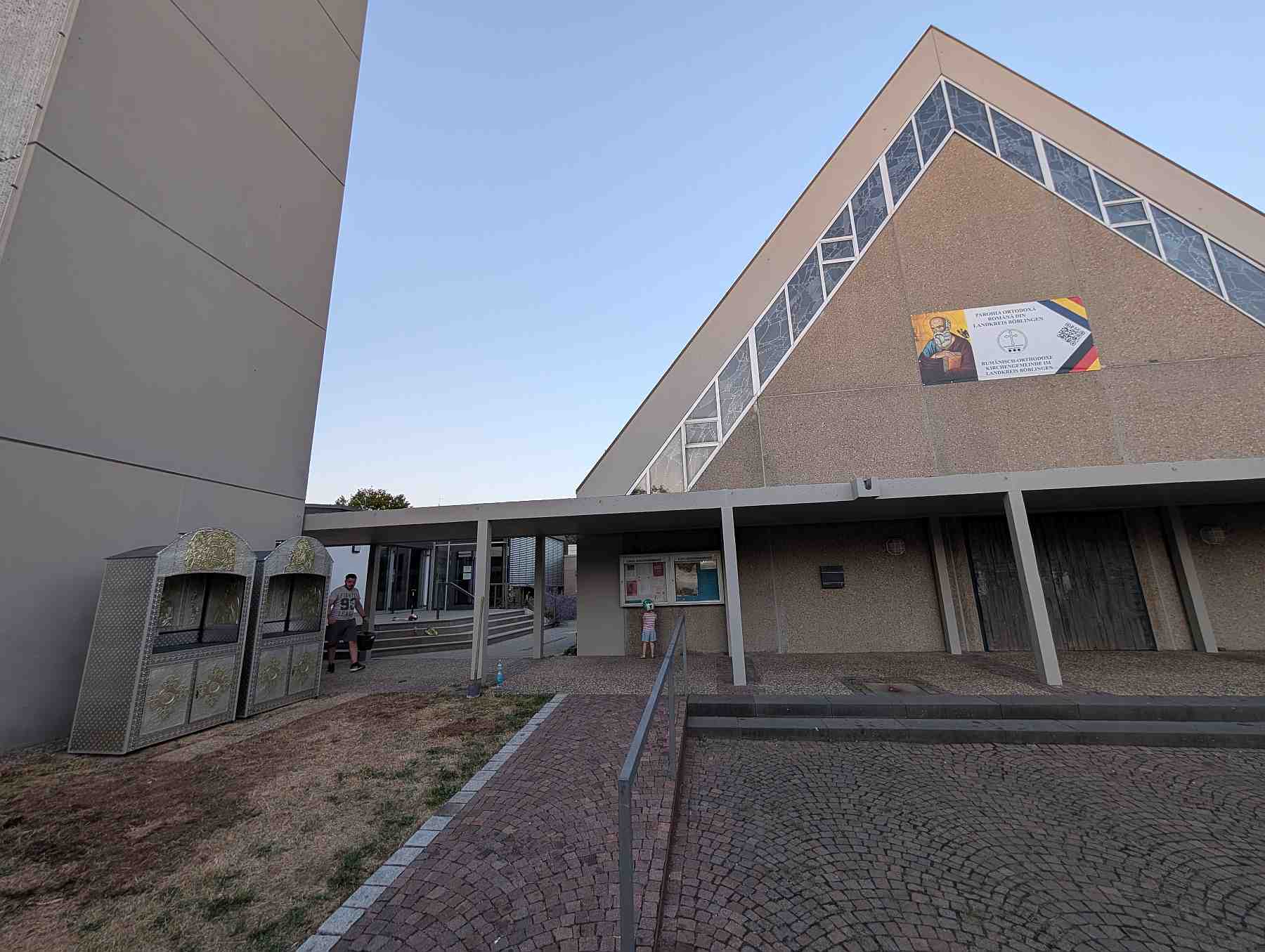
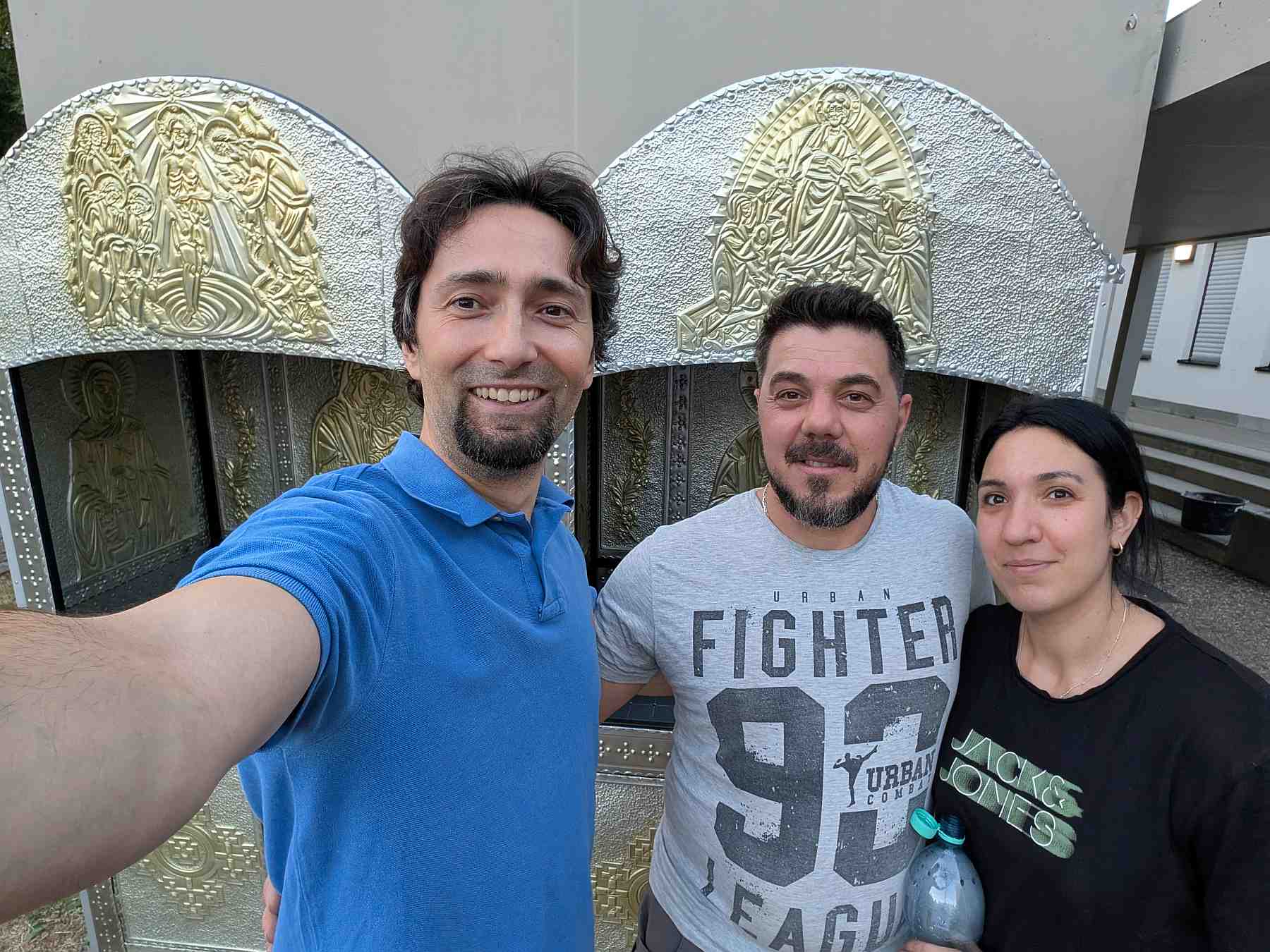
Finally, on July 28, Ionuț and Elena installed the candle burners near the church tower. Gheorghe took care that they were transported safely from Romania.
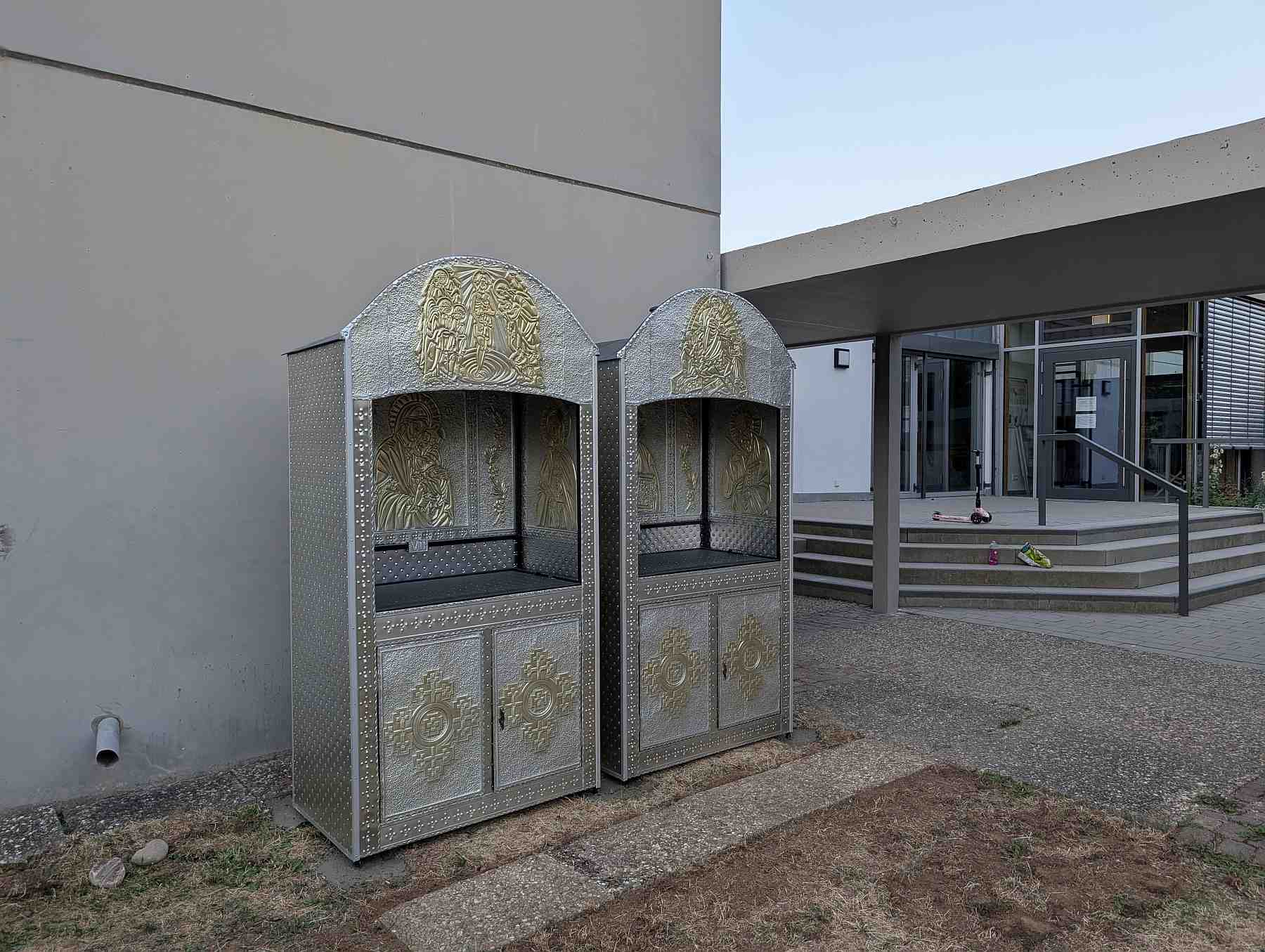
We thank all those who helped with their time and skills for these works. May God bless them with health and peace in their families!
Viehweide Summer Party
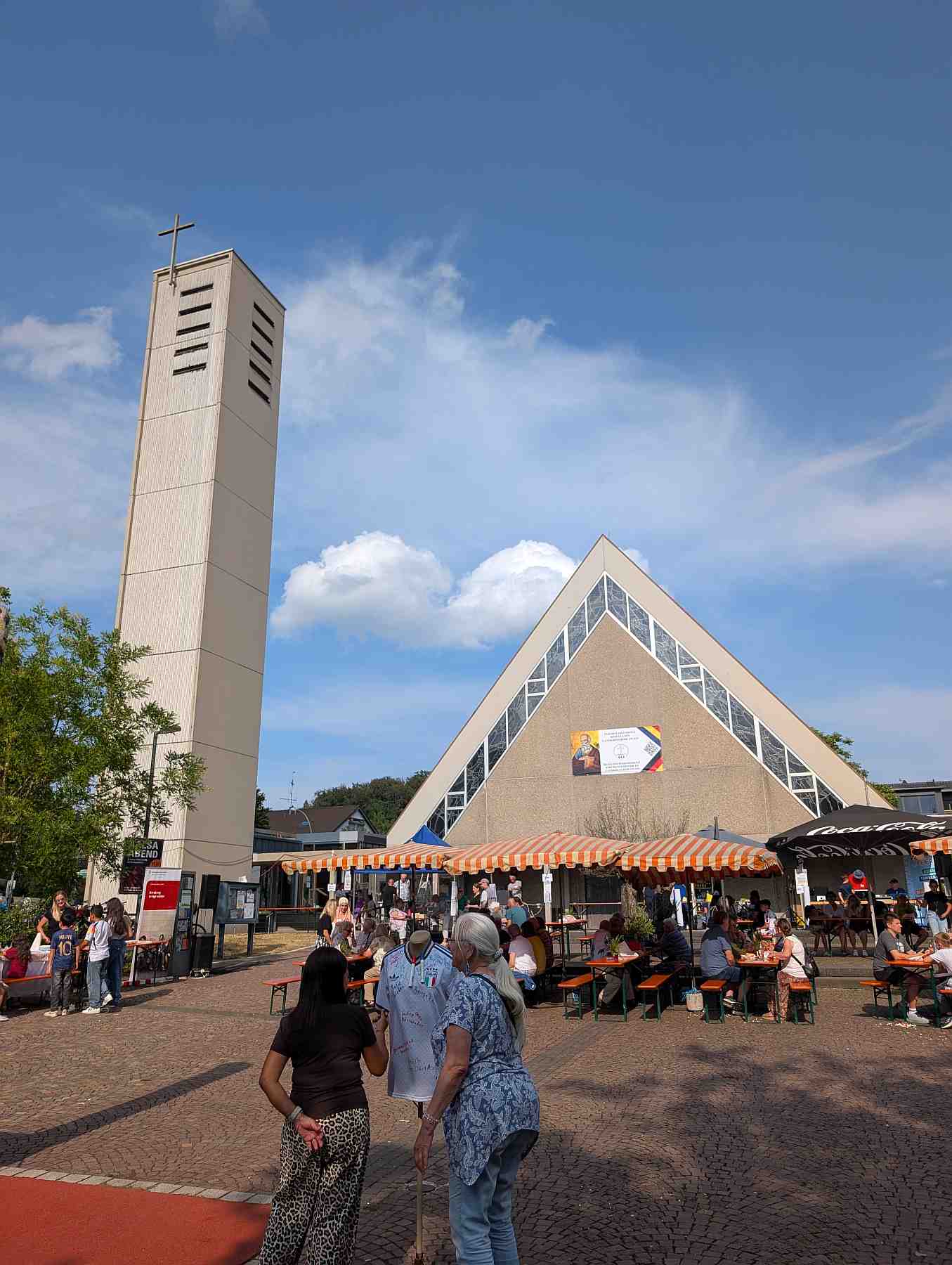
The city of Sindelfingen and the Viehweide district are still interested in religion and religious dialogue. We were present this year again, on July 18th, at the district party, where our church is located. The mayor of Sindelfingen, Markus Kleemann, and the head of the city's social service, Almut Cobet, participated, along with other employees.
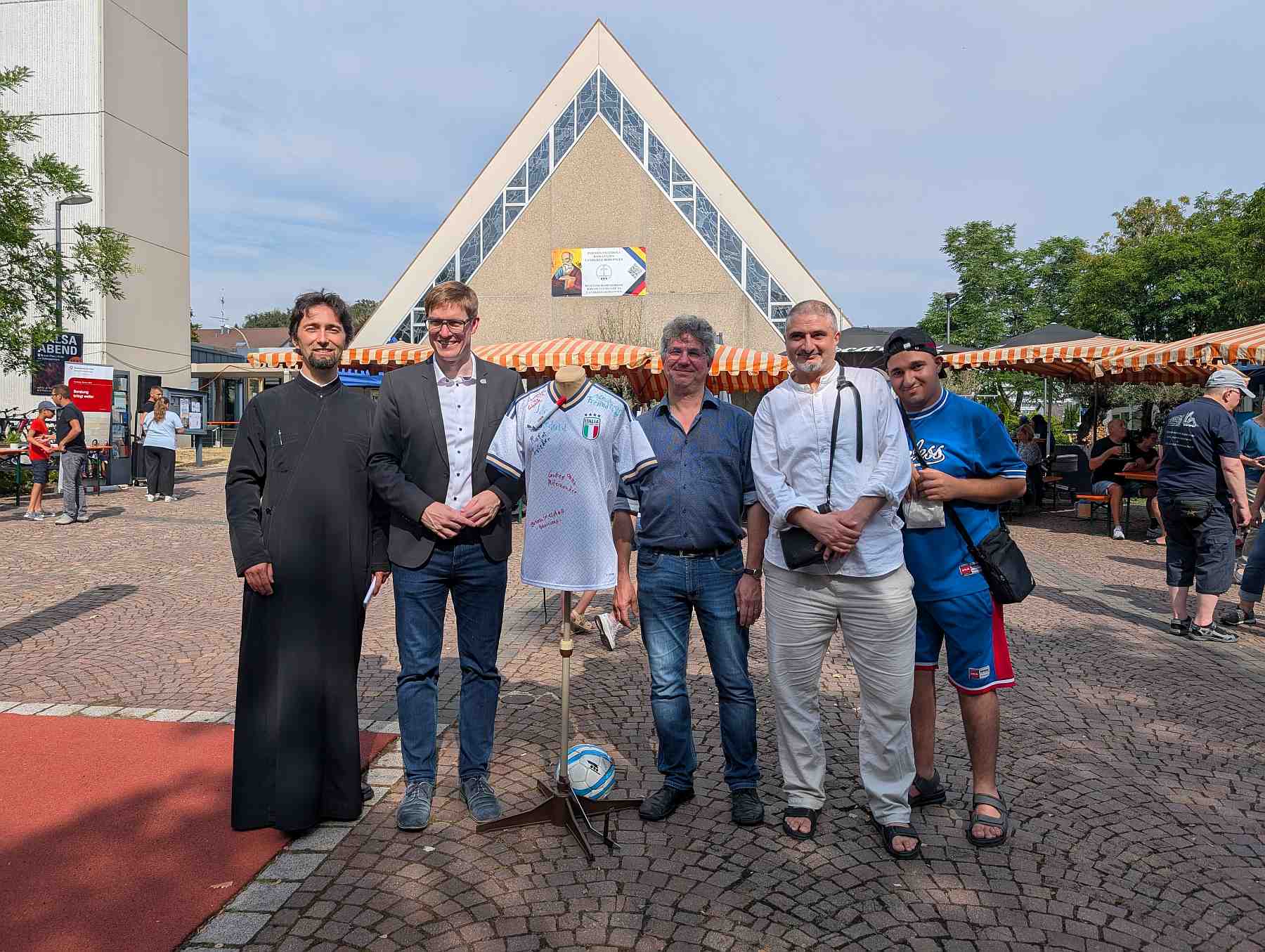
The city's interest in religion and religious dialogue is an important thing in the context of the recent increased secularization of society. Therefore, we consider our involvement in this effort to bring a genuine Orthodox contribution to be equally important.
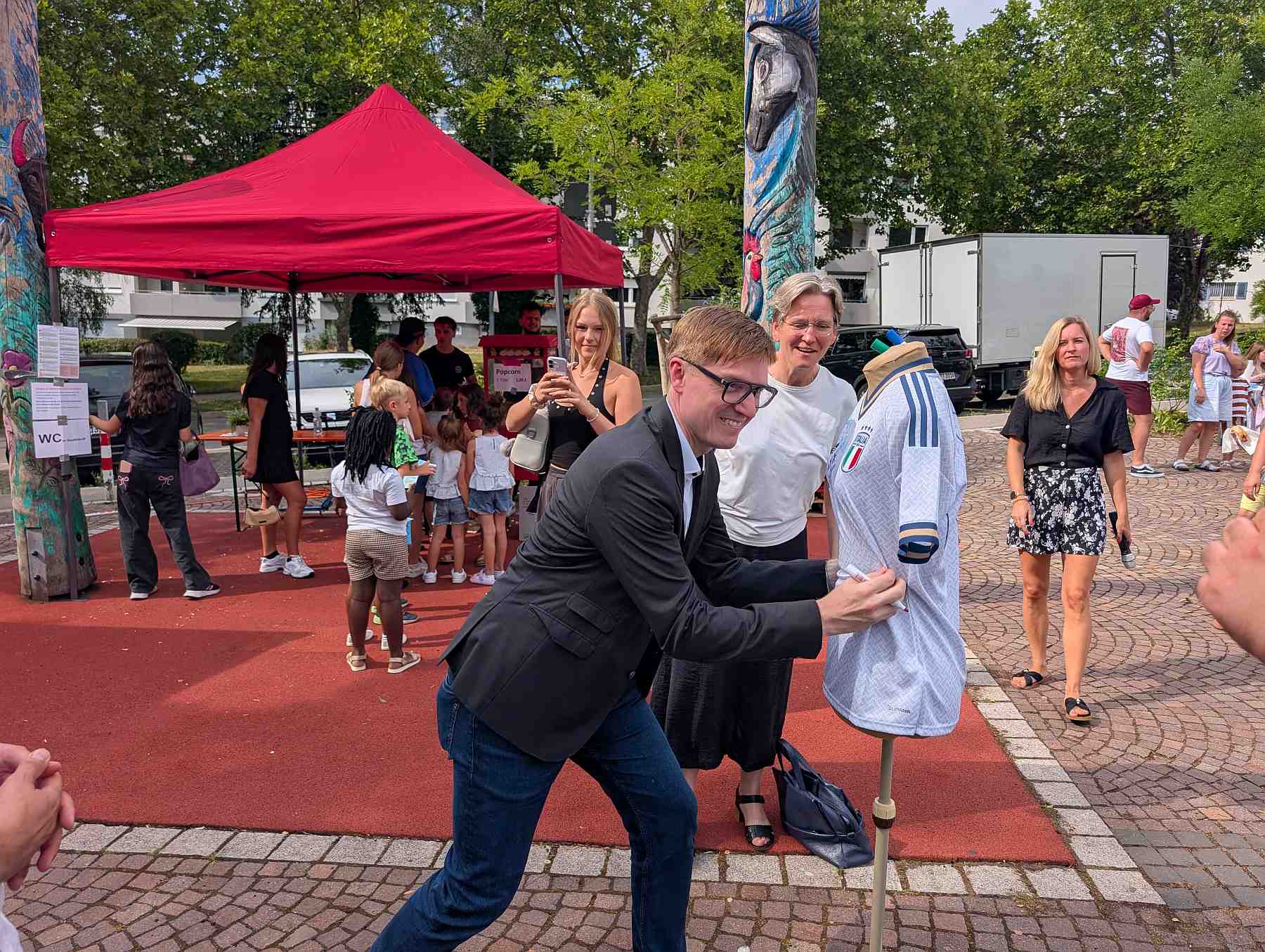
At the opening of the event, as every year, together with other representatives of religions, we supported a religious impulse. This year's theme was football. While others in America celebrate football, we celebrated community. Below we present the Orthodox contribution.
Page 1 of 5